
Service · Restoration
Bring an existing terrazzo floor back to spec.
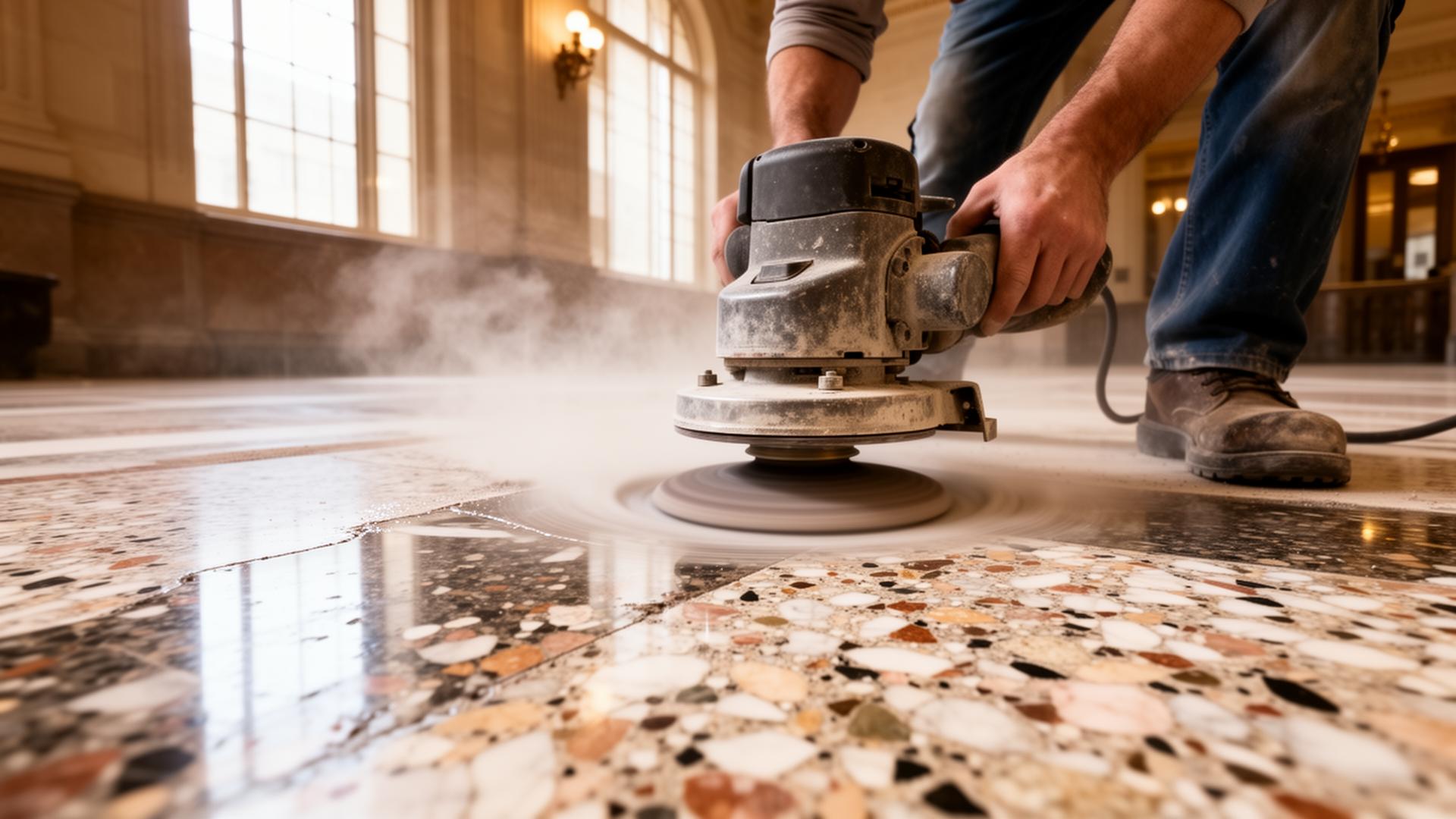
Diamond grinding, crack stitch repair, color-matched aggregate patching, and re-polish for civic, healthcare, education, hospitality, and retail floors across DFW. We restore at 30–60% of replacement cost.
Scope
What restoration actually includes.
Diamond grinding & re-polish
Coarse-to-fine diamond grinding (typically 30 → 50 → 100 → 200 → 400 → 800 grit) removes surface wear, dullness, and shallow damage. Final polish to the original specification — honed, satin, or mirror.
Crack stitch & divot repair
Hairline and structural cracks are routed, stitched with epoxy and aggregate, and feathered into the surrounding field. Divots, gouges, and impact damage are color-matched and refinished invisibly.
Divider strip replacement
Bent, corroded, or missing zinc, brass, and aluminum divider strips removed and replaced in matching gauge. Re-set in epoxy, ground flush, and re-polished with the surrounding panel.
Color-matched aggregate patching
Custom blends from our 200+ aggregate sample library match historic floors that no longer have a documented spec. We pull a 6" × 6" cutout, return a side-by-side sample inside two weeks, and patch on approval.
Slip-resistance restoration
Worn floors that fall below ANSI A326.3 DCOF 0.42 thresholds are re-textured with honed finishes or chemically etched to restore compliant traction without replacing the surface.
Sealing & maintenance handoff
Final penetrating sealer plus printed maintenance guide (chemistry, pad grits, restoration intervals) so the owner's housekeeping crew protects the investment.
Good candidates
If you have one of these floors, restoration is almost always the right call.
Terrazzo is a 75-year material. Most floors we look at have plenty of service life left under the wear layer — they just need the wear layer removed and the surface re-finished.
- Mid-century civic and school floors (1950s–1970s)
- Hospital corridors with decades of cart-wheel wear
- Hospitality lobbies between renovation cycles
- Retail with localized impact damage and stain hot spots
- Tenant-improvement floors discovered under carpet or VCT
- Floors with documented historic preservation requirements
FAQ
Restoration questions owners and PMs ask first.
Is it cheaper to restore terrazzo or replace it?
+
Restoration runs 30–60% of replacement cost on most commercial floors and avoids weeks of downtime. We do an on-site assessment, document the floor's condition, and give you both a restoration scope and a like-for-like replacement number so you can compare apples to apples.
Can you match a 1960s aggregate that's no longer manufactured?
+
Yes. We maintain a sample library of over 200 marble, granite, glass, and quartz aggregates — and partner with quarries that still produce vintage chip sizes. For unmatchable historic blends we custom-mill aggregate from quarry block.
How disruptive is restoration to a working building?
+
We work in phased zones, off-shift, or in full-building shutdowns — whatever the owner's operations allow. Wet grinding eliminates 95% of dust, HEPA vacuums handle the rest, and floors are typically walkable within 24 hours of final seal.
Do you handle asbestos mastic or hazardous adhesive removal under old floors?
+
Not directly — abatement is a licensed specialty. We coordinate with an abatement sub on the GC's behalf, then mobilize once the substrate is cleared and certified.
Send a photo. We'll send an assessment.
Site walks across the DFW Metroplex are free. We'll document condition, scope the restoration, and price both restoration and replacement so the owner can decide.
Request an Assessment