
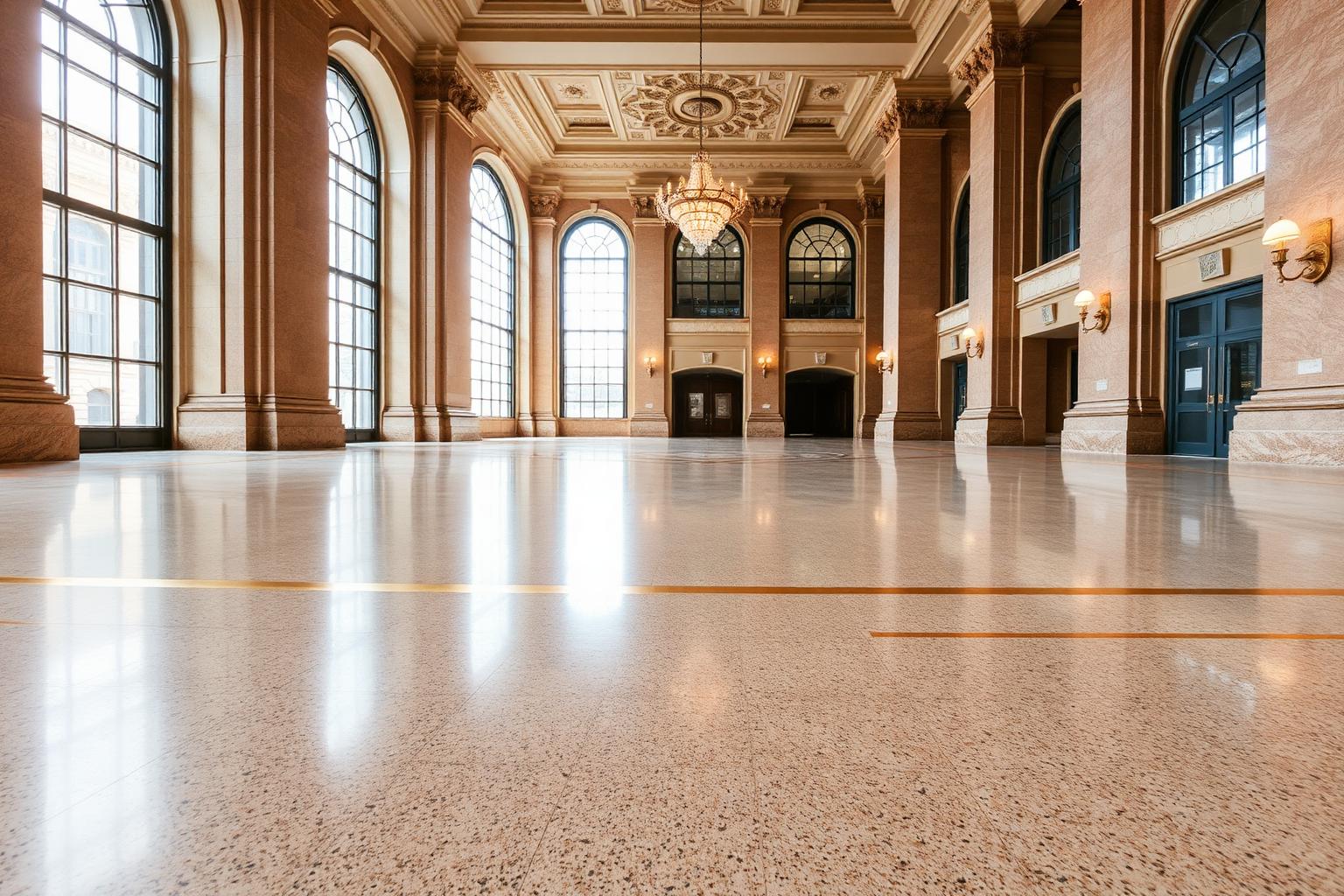
Service · Cementitious Terrazzo
Portland-cement terrazzo for exterior, historic, and heavy-load floors.
The right system when epoxy is wrong. Sand-cushion, bonded, monolithic, and thinset cementitious terrazzo installed to NTMA technical specifications.
When cementitious is right
Three cases where epoxy fails and cementitious wins.
Exterior plazas & walkways
Portland-cement matrix breathes — vapor passes through without blistering. The right call for entry plazas, covered walks, and any slab exposed to weather where epoxy would fail.
Historic matching & restoration
1920s–1960s civic, school, and courthouse terrazzo is virtually always cementitious. We replicate aggregate blends, matrix tints, and divider patterns to match additions or patch-in repairs invisibly.
Heavy-load industrial floors
At 1-1/2" to 3" thickness, cementitious systems carry forklift, pallet jack, and industrial-equipment loads that thin-section epoxy isn't engineered for.
System types
Four cementitious systems, picked by substrate.
| System | Thickness | When to spec |
|---|---|---|
| Sand-Cushion | 2-1/2" – 3" | Isolated from substrate by sand bed + isolation sheet. Best crack-resistance over questionable slabs. |
| Bonded | 1-3/4" – 2-1/4" | Bonded to sand-and-cement underbed over the structural slab. Standard for new construction with stable substrates. |
| Monolithic | 1/2" – 5/8" | Cementitious topping bonded directly to a well-cured, flat structural slab. Thinner, lighter, fast. |
| Thinset (Polyacrylate-modified) | 1/4" – 3/8" | Polymer-modified cementitious matrix at near-epoxy thickness. Hybrid for retrofit work over sound existing slabs. |
Matrix & aggregate
Natural materials, natural palette.
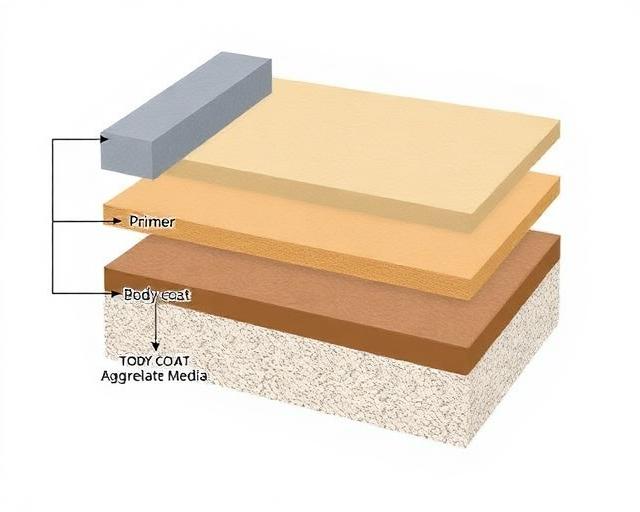
The Portland-cement matrix is integrally pigmented with mineral oxides. Aggregate selection mirrors epoxy — marble, granite, recycled glass — though deeper-toned chips read best against the cement matrix.
- Type I/II Portland cement matrix, optionally white cement for lighter tones
- Mineral-oxide pigments — UV-stable for exterior work
- Marble (#0 – #2), granite, and recycled glass aggregate
- Zinc, brass, or plastic divider strips at control joints
- Penetrating silicate or breathable acrylic sealers
Cementitious vs. Epoxy
Side-by-side, system to system.
| Criterion | Cementitious | Epoxy |
|---|---|---|
| System thickness | 1/2" – 3" | 3/8" |
| Substrate cure required | 60+ days | 28+ days |
| Vapor breathability | Permeable — exterior-rated | Non-permeable — interior only |
| Exterior application | Yes | No |
| Color brightness | Muted, natural tones | Vivid pigments, brand colors |
| Repairability | Color-match repairable indefinitely | Repairable, slight sheen variance |
| Typical use | Exterior, historic, industrial | Modern commercial interiors |
FAQ
Cementitious questions architects ask first.
Why specify cementitious over epoxy?
+
Three reasons: exterior exposure (epoxy isn't UV- or moisture-stable outdoors), historic matching (the original floor is almost certainly cementitious), and structural-load applications where a 1-1/2"+ thickness is needed to carry vehicle or equipment loads.
Can you match a 1940s school terrazzo for a new addition?
+
Yes. Bring us a sample cutout (4" × 4" minimum) or high-resolution photos with a color reference. We replicate marble-chip blends, Portland matrix tint, and zinc divider gauge to render the addition visually continuous with the original.
How does the cure schedule affect the GC's critical path?
+
Cementitious requires 5–7 days wet-cure before grinding can begin, plus another 14 days before sealer can be applied. We plan around it — typically pouring after rough-in but before any finish trades that need the floor as a work surface.
How are control and expansion joints handled?
+
Divider strips (zinc, brass, or plastic depending on application) are placed over every substrate control joint and at maximum 6'–8' o.c. in field areas. Expansion joints in the structural slab are mirrored at the terrazzo surface with full-depth flexible-fill joints.
Specifying for an exterior, historic, or industrial floor?
Send the substrate condition and the design intent. We'll pick the right system and return a sample and bid inside one week.
Request a Bid