
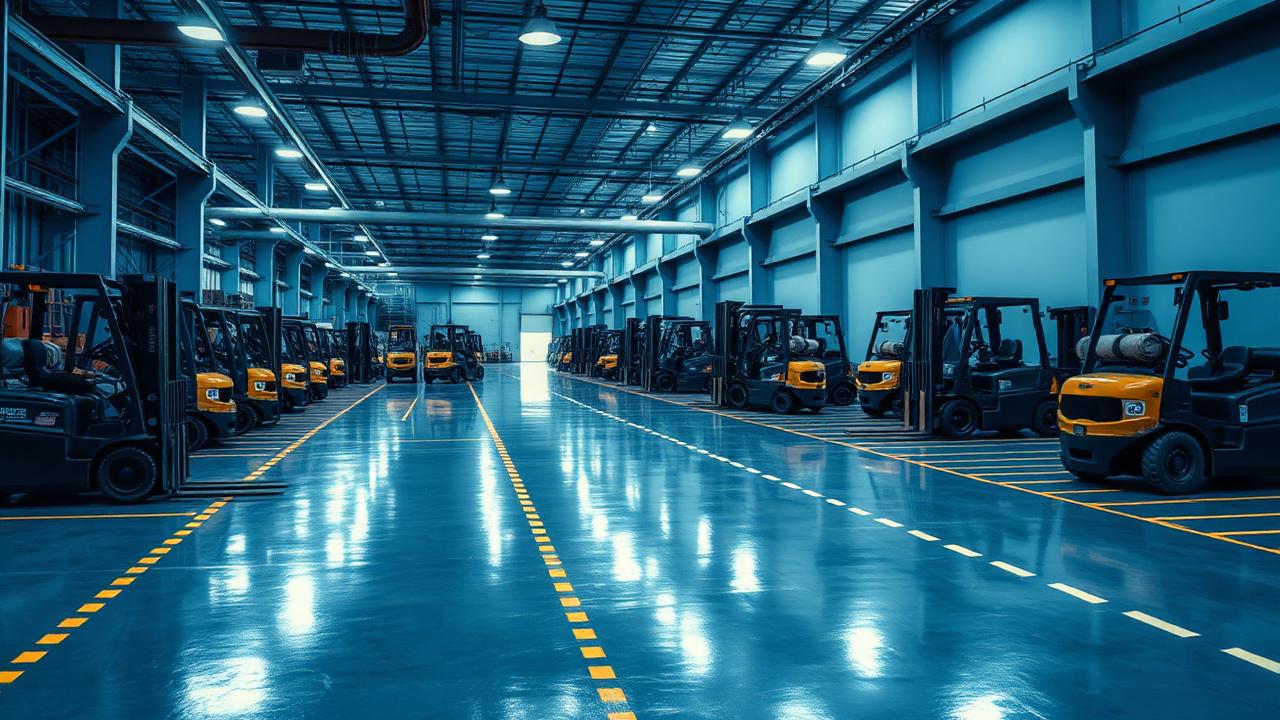
Service · Industrial Coatings
Resinous floor systems for warehouses, hangars, plants, and cleanrooms.
High-build epoxy, polyaspartic, MMA, novolac, ESD, and urethane mortar — specified to your chemical exposure, temperature range, and production schedule. Weekend turnarounds available for operating facilities.
Markets served
Specialist coatings for the facilities that can't shut down.
Warehouse & Distribution
High-build epoxy and polyaspartic for forklift and pallet-jack traffic
Aerospace Hangars
MMA fast-cure systems with hydraulic-fluid resistance, weekend turnarounds
Food & Beverage
Urethane mortar for thermal-shock, USDA/FDA-compliant cove base
Pharmaceutical & Cleanroom
Self-leveling epoxy, integral cove, ISO-classified surfaces
Manufacturing
Chemical-resistant novolac for process areas and battery rooms
Automotive & EV
ESD and anti-static systems for assembly, paint, and battery production
System catalog
Six system families, picked by exposure and schedule.
High-build Epoxy
20 – 60 milsPigmented 100%-solids epoxy applied in multiple coats. Workhorse for warehouse, retail back-of-house, and light manufacturing.
Polyaspartic / Polyurea Flake
30 – 50 milsFast-cure topcoat over epoxy basecoat with broadcast vinyl flake. Returns to service in 24 hours; UV-stable for daylit spaces.
MMA (Methyl Methacrylate)
1/8" – 1/4"Cures in 1–2 hours at temperatures down to −20°F. Used for freezer floors, weekend hangar reseals, and 24/7 facility shutdowns.
Chemical-resistant Novolac
60 – 125 milsCross-linked epoxy novolac for battery rooms, plating shops, and chemical processing — resists concentrated acids and solvents.
ESD / Anti-static
40 – 80 milsConductive primer + dissipative topcoat tested to ANSI/ESD S20.20 and S7.1. EV battery, electronics, and ordnance facilities.
Urethane Mortar
1/4" – 3/8"Cementitious urethane for food, beverage, and dairy plants. Survives thermal shock from steam cleaning and quench-tank splash.
Moisture mitigation
The line item that saves the schedule.
Coating failures on industrial slabs are almost always moisture failures. We test before we commit to a system, and we bid moisture mitigation as a separate line so the spec doesn't get value-engineered out before the slab is even tested.
- ASTM F2170 in-situ relative-humidity probes — 3 per 1,000 sq ft minimum
- ASTM F1869 calcium chloride backup testing when required
- 100%-solids epoxy vapor barriers rated to 100% RH / 25 lb MVER
- Surface prep to ICRI CSP 3–4 per coating-system requirement
- Documentation package — test reports, photos, manufacturer sign-off

Performance envelope
The numbers you put in the spec.
- Compressive strength
- 10,000+ psi (ASTM C579)
- Abrasion resistance
- ASTM C501 / D4060 — system-dependent
- Chemical resistance
- Per spec — novolac to 50% sulfuric, MMA to 70% phosphoric
- Temperature range
- −40°F to 250°F continuous (urethane mortar)
- Cure-to-traffic
- 1 hr (MMA) – 24 hr (epoxy/polyaspartic)
- Slip rating
- ≥ 0.6 SCOF (ASTM D2047), aggregate broadcast adjustable
- ESD performance
- 10⁴ – 10⁹ ohms (ANSI/ESD S20.20)
- VOC
- < 50 g/L typical, 0 g/L 100%-solids
FAQ
Industrial coatings questions GCs and facility managers ask first.
Can you do a weekend pour to avoid production downtime?
+
Yes — MMA and fast-cure polyaspartic systems are specifically engineered for it. Friday-evening shutdown, surface prep through Saturday, coating application Saturday night, return to service Monday morning. We've turned 25,000 sq ft of hangar floor inside a 48-hour window.
MMA vs. polyaspartic — which should I spec?
+
MMA when cure speed is non-negotiable (cold storage, 24/7 facilities, hospital corridors) or when temperature is below 40°F. Polyaspartic when UV exposure matters and a 24-hour return is acceptable. Polyaspartic is cheaper; MMA is faster and tougher in extreme conditions.
How do I match a coating system to my chemical exposure?
+
Send us the SDS list of substances the floor will see and their concentrations. We cross-reference the coating manufacturer's chemical-resistance chart and recommend epoxy, novolac, or urethane based on actual exposure — not generic 'chemical resistant' marketing language.
Should moisture mitigation be a separate line item on the bid?
+
Yes — and we encourage GCs to bid it that way. We run ASTM F2170 in-situ RH probes before any system is committed. If RH > 75%, we install a 100%-solids epoxy vapor barrier as a separate line item. Bidding it separately protects everyone if the slab test comes in high.
Production floor, hangar bay, or cleanroom — same week response.
Send the slab age, the chemical exposure list, and the shutdown window. We'll pick the right system and confirm a weekend pour date.
Request a Bid