
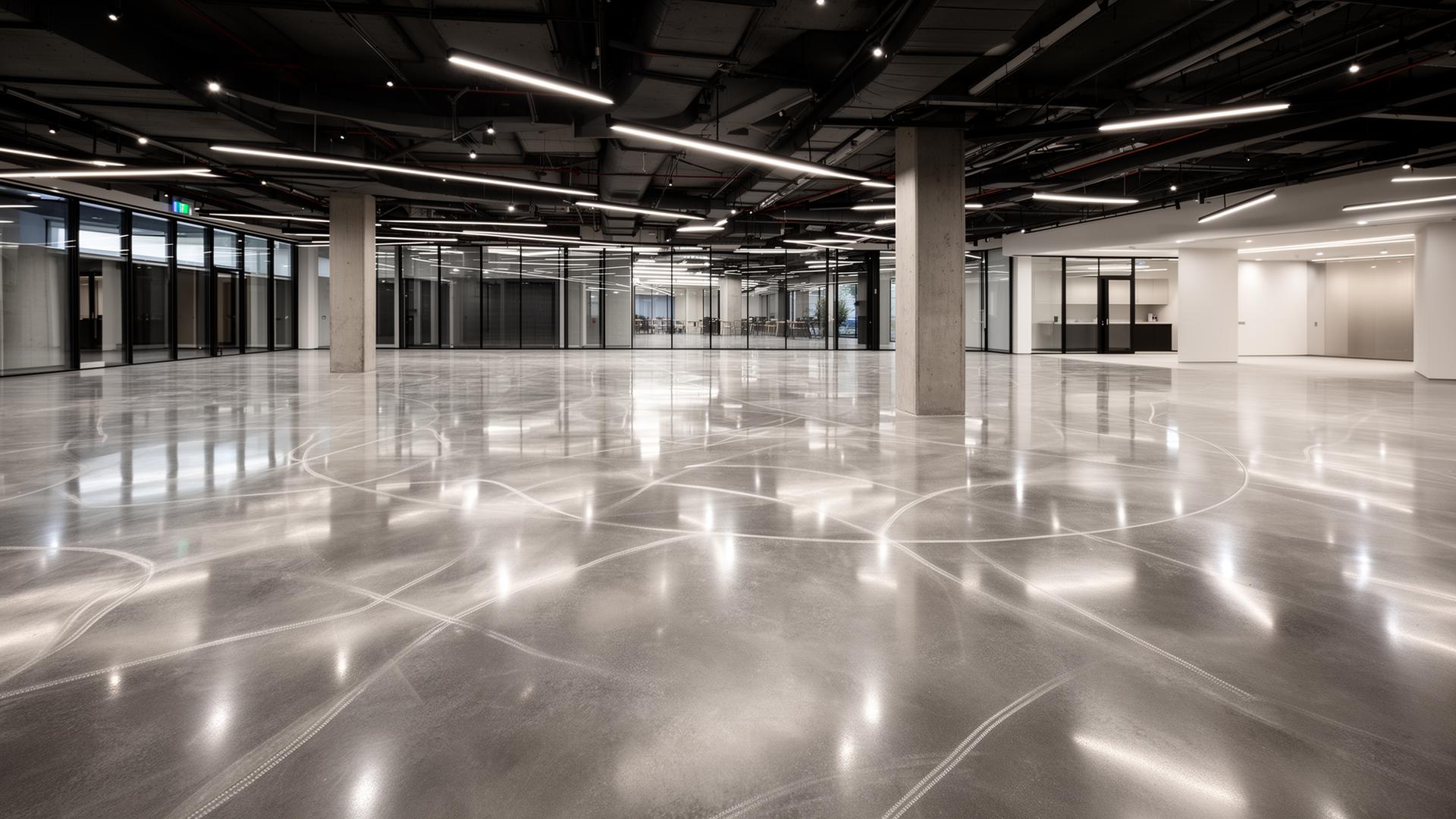
Service · Polished Concrete
When terrazzo isn't in budget, polish what's already there.
Mechanically polished, densified concrete to CPAA Class A, B, or C exposure with optional dye, stain, and decorative saw cuts. Lowest installed cost of any architectural finish floor in commercial construction.
CPAA aggregate exposure
Three exposure classes. Specify once.
Per the Concrete Polishing Association of America, exposure class defines how much aggregate is revealed by the initial grind. Pick the class on the drawings; we hit it on the slab.
Class A — Cream
No aggregate exposed. Uniform cement paste finish, lowest cost.
Class B — Fine aggregate
Salt-and-pepper exposure of fine sand. Most common commercial spec.
Class C — Coarse aggregate
Full stone exposure. Terrazzo-like appearance at a fraction of the cost.
Gloss level
Four gloss levels, matched to use.
| Level | Final grit | Appearance |
|---|---|---|
| Level 1 — Flat | 100 grit | Matte. No reflection. |
| Level 2 — Satin | 400 grit | Low sheen, soft reflection. |
| Level 3 — Semi-polished | 800 grit | Medium sheen, defined images. |
| Level 4 — Highly polished | 1500–3000 grit | Mirror finish. |
Why polished concrete
The slab is the finish.
No coating layer to delaminate. No tile to crack. No carpet to replace. Polished concrete is the structural slab itself, densified chemically and ground to spec — restorable indefinitely.
- Lowest installed cost of any architectural finish floor
- Uses the existing concrete slab — minimal added weight or height
- Densified surface resists abrasion, oil, and chemical staining
- Contributes to LEED MR (no new material) and IEQ (zero VOC)
- Reflects ambient light — reduces lighting load 30–60%
- Dyes and saw cuts allow brand colors and wayfinding patterns
FAQ
Polished concrete questions PMs ask first.
When does polished concrete make sense instead of terrazzo?
+
When budget is the primary driver, when the existing slab is in good condition, or when the design calls for a more industrial aesthetic. Polished concrete runs roughly 25–40% of epoxy terrazzo's installed cost and uses the slab that's already there.
Can you polish an existing slab, or does it need to be new?
+
Both. New slabs give the best results because we control mix design and finishing. Existing slabs 5+ years old typically polish beautifully too — we test a small area first to confirm hardness, joint condition, and aggregate distribution before committing to a full scope.
How does polished concrete compare to coated concrete (epoxy, urethane)?
+
Polished concrete is the slab itself — densified and ground to a finish. Coatings sit on top and eventually delaminate, scratch, or peel. Polished concrete has no coating to fail and is restorable forever with re-grind and re-polish.
What's the maintenance like?
+
Daily auto-scrub with neutral cleaner. Quarterly burnish with a high-speed pad. Annual penetrating densifier re-coat if traffic warrants. A printed maintenance schedule ships with every project closeout.
Bid-day clarity on aggregate, gloss, and add-alts.
Send the slab specs and finish schedule. We'll bid the base scope, quote dye and saw-cut add-alts separately, and turn it inside 5 business days.
Request a Bid