
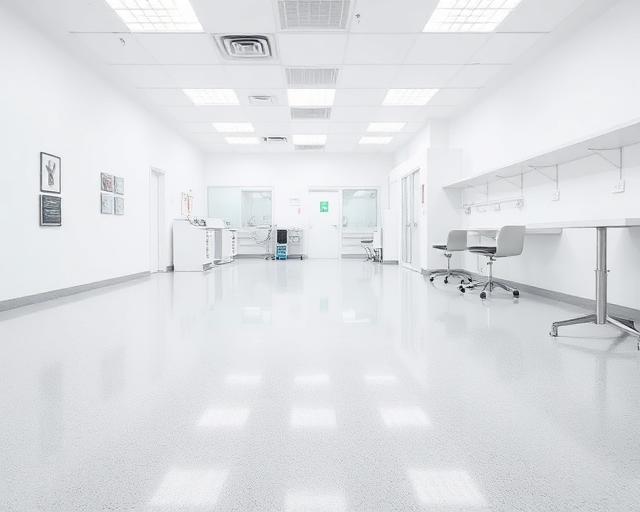
Industry · Healthcare
Terrazzo and resinous floors for hospitals, clinics, and MOBs.
Monolithic, seamless flooring that passes infection-control review, holds up to bed and equipment traffic, and stays serviceable for decades — installed around live operations across DFW.
What this floor has to survive
The conditions that make spec selection non-trivial.
Infection control
Joint Commission and CDC environmental-services standards push toward seamless, non-porous, easily disinfected floors. Tile grout lines and resilient seams collect biofilm; terrazzo and resinous matrices don't.
24/7 operations
You can't close a med-surg unit for a week. Work is phased corridor-by-corridor with infection-control risk assessments (ICRA), negative-air containment, and night-shift pours when needed.
Wheeled-load punishment
Crash carts, MRI gantries, food carts, and 600-lb beds all roll across the same square foot daily. Wheel chatter, point loads, and chemical spills demand a system that can't gouge or delaminate.
Recommended systems
Three systems we install most often in healthcare.
We bias toward seamless, monolithic matrices and avoid anything with field-applied grout joints, regardless of finish appeal.
Epoxy Terrazzo
3/8" monolithic, zero porosity, integral cove base option. The default for lobbies, corridors, and any space the public sees.
System detailsUrethane Mortar (Industrial Coatings)
Back-of-house: central sterile processing, kitchens, morgues, mechanical. Thermal-shock and chemical resistance beyond what terrazzo can offer.
System detailsPolished Concrete
Diagnostic imaging suites and labs with strict static-load and EMI requirements where the structural slab itself is the finish.
System detailsSpec highlights
The numbers that show up in the submittal.
- VOC compliance
- SCS Indoor Advantage Gold
- Coefficient of friction (wet)
- ≥ 0.6 (ANSI A137.1)
- Integral cove base
- 4" – 6" coved up wall
- Chemical resistance
- Hospital-grade disinfectants OK
- Service life
- 40–70+ years (terrazzo)
Schedule reality
How we work around the operation.
We've delivered terrazzo and resinous floors inside occupied DFW hospitals for over two decades. Every phase is sequenced with the ICRA team, with HEPA containment, negative-air machines, and route-of-travel planning that protects patients and staff.
- Phased pours by zone
- Night-shift and weekend crews on request
- Vapor and dust containment for occupied spaces
- Daily progress reports to GC superintendent
FAQ
What this industry asks first.
Is epoxy terrazzo compliant with infection-control protocols?
+
Yes. The cured 3/8" matrix is monolithic and non-porous. With an integral cove base coved up the wall 4–6", there is no joint between floor and wall for biofilm to colonize — exceeding most hospital EVS specifications.
Can you work inside an occupied wing?
+
Yes. We run night and weekend shifts, build HEPA-filtered negative-air containments, and coordinate with the infection-control practitioner on ICRA Class III/IV protocols. Most occupied-wing pours run 7 PM – 5 AM with full handoff each morning.
How does terrazzo compare to sheet vinyl on lifecycle cost?
+
Sheet vinyl replaces every 12–15 years. Heat-welded seams fail before that. A 70-year terrazzo floor at 4x the install cost still wins on 60-year cost-per-square-foot by a 3:1 margin — without counting the lost-occupancy cost of every recarpet cycle.
Do you handle MRI-suite static-load and EMI constraints?
+
Yes — for diagnostic imaging suites we typically spec a densified polished concrete or a specialty static-dissipative epoxy depending on the equipment manufacturer's drawings. We coordinate directly with the OEM rep on slab-flatness and EMI requirements.
Specifying floors for a DFW healthcare project?
Send the program, the phasing constraints, and the ICRA class. We'll come back with a system recommendation, a sample, and a bid that respects your night-shift reality.
Request a Bid