
Industry · Education
The 70-year floor that outlasts every bond cycle.
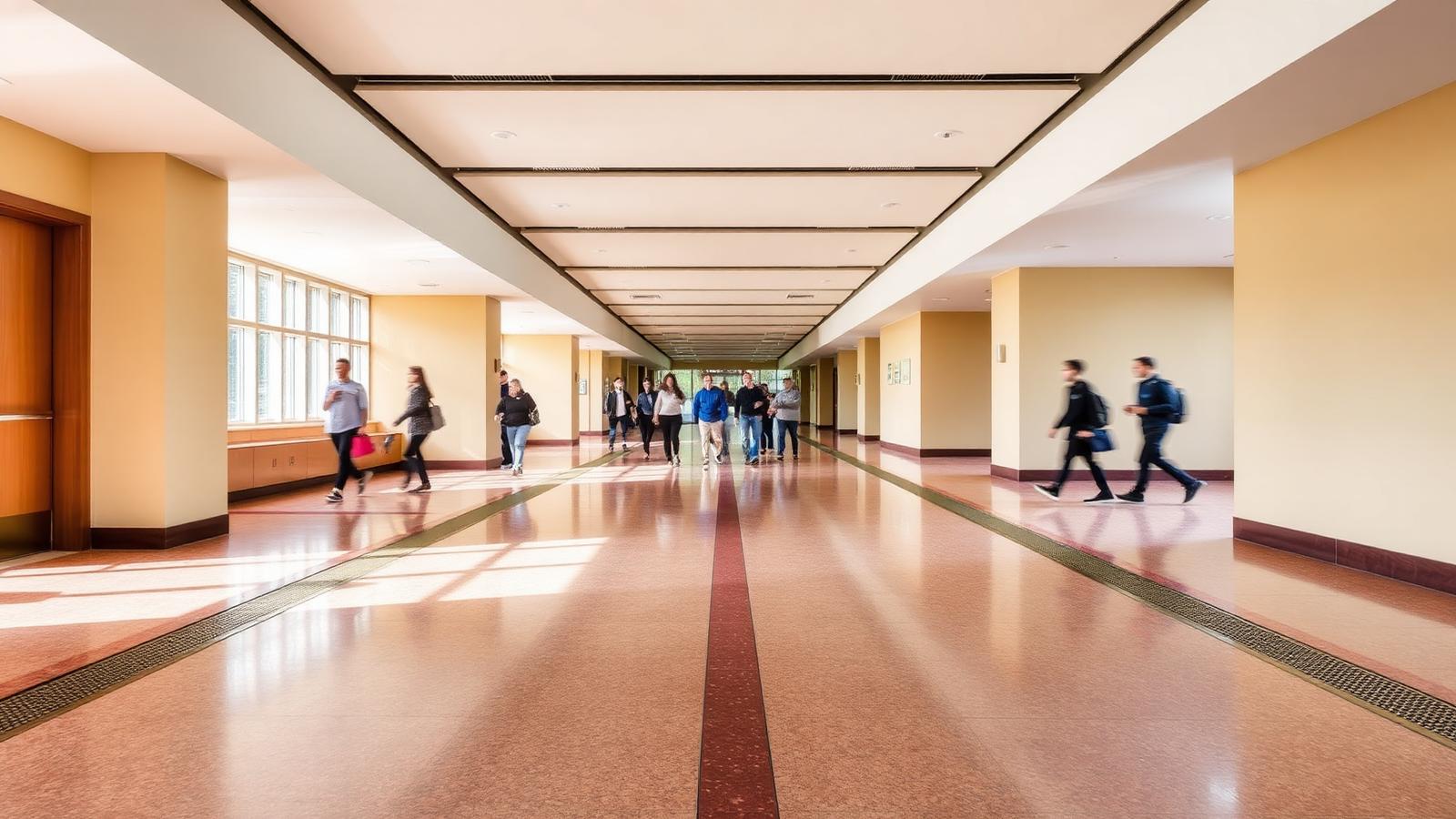
K–12, university, and CTE buildings. Terrazzo specified once in 1965 is still in service in DFW schools today — and modern epoxy terrazzo extends that legacy with brighter colors and faster install.
What this floor has to survive
The conditions that make spec selection non-trivial.
Summer-only windows
K-12 work effectively has a 9-week window between graduation and back-to-school. Anything that doesn't finish by mid-August costs the district a delayed start.
Lifecycle accountability
School-board CFOs evaluate floor systems on 50-year cost-per-square-foot, not first cost. Terrazzo wins every comparison once recarpet cycles enter the math.
Historic matching
Many DFW ISDs add wings to mid-century buildings with original cementitious terrazzo still in service. New work has to read continuously with 60-year-old aggregate blends.
Recommended systems
Three systems we install most often in education.
Educational facilities are where terrazzo's lifecycle math is most defensible. We pair it with polished concrete for CTE shops and corridors where budget priorities differ.
Epoxy Terrazzo
Corridors, commons, libraries, cafeterias. School-color aggregate and mascot medallions baked in for the next 50 years.
System detailsCementitious Terrazzo
Additions to historic mid-century campuses. Matches existing matrix and aggregate so the seam disappears.
System detailsPolished Concrete
CTE shops, gymnasium corridors, and back-of-house. Budget-aligned without sacrificing durability.
System detailsSpec highlights
The numbers that show up in the submittal.
- Service life
- 70+ years (terrazzo)
- Recarpet cycles avoided
- 5–6 over building life
- Summer-window completion
- 10,000 SF / 8 wk crew
- School-color aggregate
- Brand-matched glass + marble
- Slip rating
- DCOF ≥ 0.42 (ANSI A137.1)
Schedule reality
How we work around the operation.
K-12 mobilization typically starts the Monday after graduation with substrate prep and divider layout. Cementitious systems need to begin Week 1 to make the cure schedule; epoxy can start as late as Week 3 and still finish on time.
- Phased pours by zone
- Night-shift and weekend crews on request
- Vapor and dust containment for occupied spaces
- Daily progress reports to GC superintendent
FAQ
What this industry asks first.
Can the cost-per-square-foot really beat VCT or carpet over 50 years?
+
Yes — by a wide margin. VCT replaces every 10–15 years; carpet every 7–10. Six replacement cycles plus disposal plus lost-instruction days during install vs. one terrazzo install with periodic re-polish. The 50-year math typically lands at 2–3x lower lifecycle cost for terrazzo.
We're adding a wing to a 1955 elementary school. Can the new floor match?
+
Yes, and we'd specify cementitious — the original is almost certainly Portland-cement matrix terrazzo. We pull a 4" sample from the existing floor, blend a matching matrix tint and aggregate gradation, and the new pour reads as one continuous floor across the construction joint.
Can a school mascot or seal be inlaid?
+
Yes. Mascot medallions in entry rotundas and main corridors are standard offerings — typically 4'–8' diameter, brass divider outlines, four to six aggregate colors. Lead time on the medallion design and divider fabrication is 4–6 weeks from approved artwork.
How fast can you install during a summer shutdown?
+
A typical 15,000 SF middle-school corridor and commons completes in 5–6 weeks: 1 week prep, 1 week divider, 1 week pour and cure, 1 week grind, 1 week seal and punch. We mobilize multiple crews for districts with several buildings in flight.
ISD or higher-ed project on the boards?
Send the program and the bond schedule. We'll return a system recommendation, lifecycle cost comparison, and a sample tuned to school colors inside two weeks.
Request a Bid